
 Spain · Summer 1614
Two days, one vigil, and a knighthood
On a July morning before dawn I armed myself and rode out of my village, without telling a soul, to set right the wrongs of the world. I was home again the next night, on a neighbour's donkey. Both things are true.


- When
- 28 – 29 Jul 1614
- How long
- 2 days
- Who went
- Me and Rocinante
- Stops
- 2
- Getting around
- On Rocinante, and home across a donkey
Trip details
- Who went
- Me and Rocinante
- Getting around
- On Rocinante, and home across a donkey
In this story · 3 chapters
I have been asked, by my niece among others, and more sharply by my housekeeper, how a gentleman of some fifty years, sound in his habits and regular at Mass, came to set out upon the roads of La Mancha in search of wrongs to right. The question deserves an answer, and since the history of my deeds will one day be written by a learned hand, I think it only courteous to furnish the first chapter myself, so that the chronicler need not guess.
I am a man of modest estate. My house is respectable, my table plain, my best coat kept for feast days, and my income just sufficient to keep all three in the condition I have described. I rose early, I went after hares now and then with a greyhound who was faster in his youth than I was in mine, and I was, I confess, a man with a great deal of idle time.
01 The books
It was the idle time that did it, or rather what I chose to fill it with. I began to read books of chivalry, at first for an hour after supper and then, it fell out, for whole nights together and whole days besides. I sold acres of good wheat land to buy more of them. My shelves filled with Amadís of Gaul, with Palmerín of England, with Belianís of Greece and his countless wounds, with the deeds of Roland and the Twelve Peers of France. The priest of our village, Pero Pérez, a learned man who took his degree at Sigüenza, would argue with me over which was the better knight, Palmerín or Amadís. Master Nicolás the barber held out for the Knight of Phoebus, and I respected him for it, though he was wrong.
My niece says the books dried out my brain. I say they watered it. In those pages I found the truth that our age has forgotten: that the world is full of widows wronged, orphans robbed, maidens carried off and giants grown insolent, and that it was once the business of certain men to ride out and set these things right, asking nothing in return but honour. Reading on, night after night, I began to ask myself a very simple question. If the world still needs such men, and plainly it does, where are they?
No one answered. So I answered myself.

02 Armour, horse and name
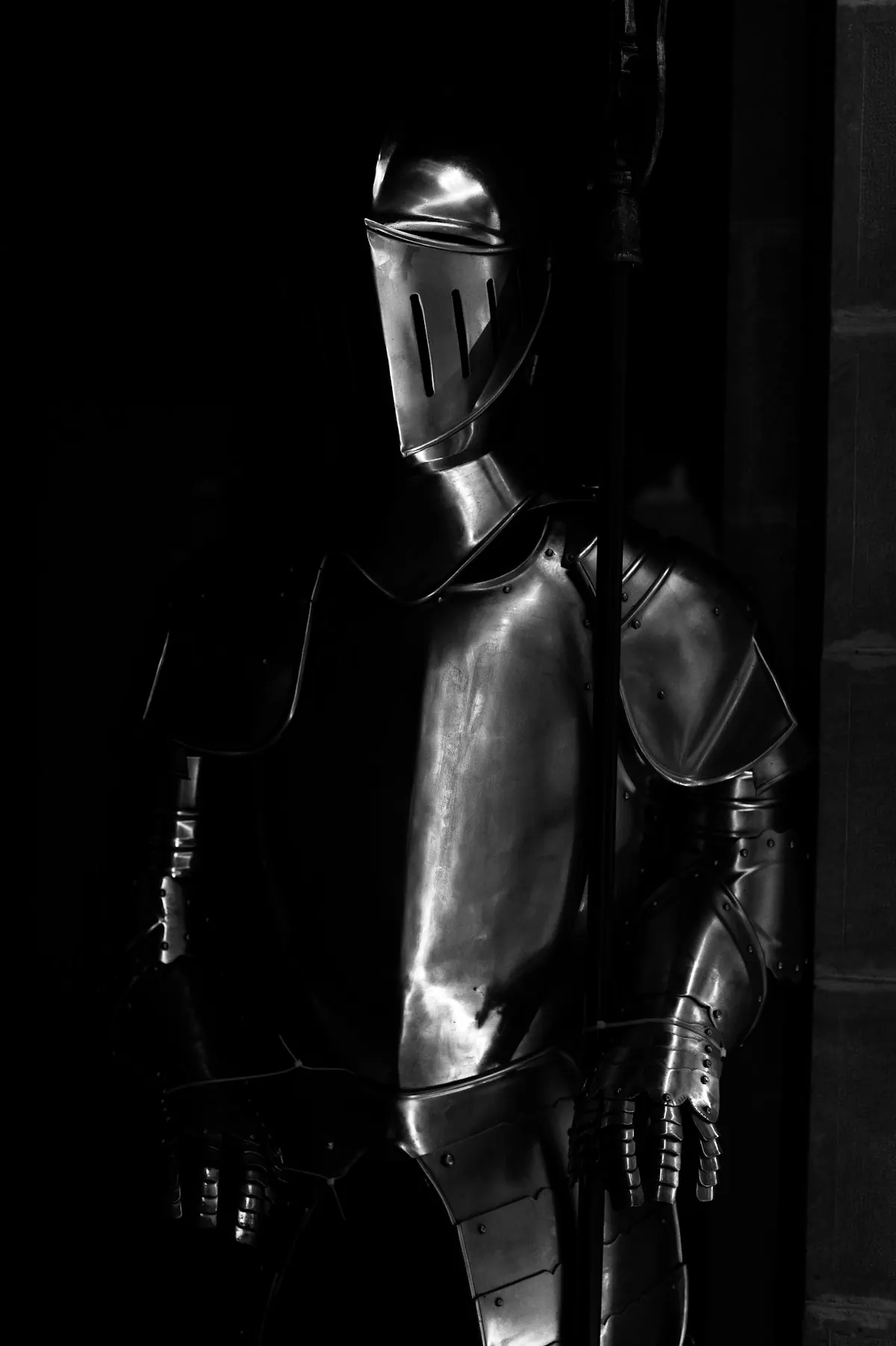
The first task was armour. In a corner of the house lay a suit that had belonged to my great-grandfather, rusted and spotted with mould and forgotten for a century. I scoured it and mended it as well as I could. It had one grave fault: there was a morion, a simple open cap, but no closed helmet with a visor, and a knight without a visor is like a castle without a gate. I solved this with my own hands. Out of pasteboard I fashioned a half-helmet that fixed to the cap, and it looked, I may say, entirely convincing.
Being a careful man, I wished to know whether it would stand a blow. I drew my sword and gave it two good strokes. With the first I undid in a moment what had taken me a week to make. This troubled me, I admit. I set to work again and made it a second time, now with strips of iron fastened inside, until I was satisfied it was strong. I did not test it again. There are things a knight must take on faith, and I judged this to be one of them.
Next, my horse. He is a tall animal, and some uncharitable neighbours have counted his ribs aloud, but to my eyes neither Alexander's Bucephalus nor the Cid's Babieca could match him. A knight's horse must have a name worthy of the deeds he will carry his master into, and I spent four days choosing one. I wanted a name that would say what he had been before, a mere nag, and what he was about to become, the first of all the steeds in the world. At last I settled on Rocinante: lofty, sonorous, and meaning, to the attentive ear, a hack that has risen above all hacks. He took it with great dignity.
If the horse took four days, I could hardly allow myself fewer. I spent eight on my own name. I had been Alonso Quijano all my life, which is a decent name for a gentleman who hunts hares, but no name at all for a knight. In the end I took my lead from Amadís, who did not content himself with being plain Amadís but called himself Amadís of Gaul, after his kingdom. I would do the same for my own country and make it famous. I became Don Quixote de la Mancha. I said it aloud in the stable, and Rocinante lifted his head.
03 A lady, and a morning in July
One thing still was lacking, and it was the most important of all. A knight errant with no lady is a lamp with no oil: handsome enough on the shelf, and of no use to anyone in the dark. If I should meet a giant on the road, as knights commonly do, and overthrow him, whom would I send him to, to kneel and confess himself conquered? There had to be a lady.
Not far from my village, in El Toboso, there lived a young woman I had once admired, though she never knew it and I never told her. Her name was Aldonza Lorenzo, and she was, my housekeeper informs me, a farm girl with a strong arm for salting pork. I did not consider this an obstacle. I sought a name for her that would sit well beside my own and lean towards that of a princess and great lady, and I named her Dulcinea del Toboso: musical, rare and full of meaning, like everything else I had named. From that hour she has been the mistress of my thoughts, and I have not been able to think of her without a kind of trembling.
I told no one my plans. My niece would have wept and my housekeeper would have hidden my lance. So on a morning near the end of July, one of the hottest of the year, I rose before dawn, put on my armour, laced my visor, took up my shield, mounted Rocinante and rode out through the back gate of my yard into the open fields. My joy was so great that I could hardly sit the saddle.
Then, barely out of sight of the village, a terrible thought struck me. I had not been dubbed a knight. By the laws of chivalry I could not, and must not, take up arms against any knight until I had been. This nearly turned me back. But my madness, as my niece would call it, or my resolve, as I call it, carried me on. I decided I would be knighted by the first person I met, as many knights in the books had been, and I rode on, letting Rocinante choose the road, since that is what the true adventure demands.

| Item | Condition | Notes |
|---|---|---|
| Armour (my great-grandfather's) | Scoured; serviceable | A century of rust removed with sand and patience. Some spots remain; I call them honourable. |
| Visor (pasteboard, iron-strengthened) | Excellent, by faith | First version undone by one sword-stroke. Second version not tested, as a matter of principle. |
| Lance | Old but straight | Taken from the rack in the hall. Long unused, therefore well rested. |
| Shield | Old, sound | Ancient pattern. No device painted on it yet; a knight earns his device. |
| Rocinante | Lean, willing | Four days to name. Superior to Bucephalus and Babieca in every respect except weight. |
| Money | None | The books never mention knights carrying it. An innkeeper has since advised me otherwise. |
| Clean shirts | None | See the note above. I have been advised on this as well. |
| A lady | Peerless | Dulcinea del Toboso. Not yet informed. |
I set this inventory down so that any young gentleman who reads it and feels the same call may know what is needed, and what, it seems, is also needed though the books leave it out. I will tell in my next account how I came to a castle that evening, how I kept my vigil of arms, and how I was made a knight at last.
Read nextA vigil of arms at the castle (some call it an inn)What happened at nightfall on that first day.
To the wise historian who will one day set down these deeds: the visor is strong. Should any enchanter tell you otherwise, ask him whether he tested it twice.
A village in La Mancha