
 Spain · Summer 1614
Part of: The second sally, with Sancho Panza · 1 of 10
1 · Campo de Criptana · 20 – 21 Aug
The giants of Criptana


Trip details
- When
- 20 Aug – 14 Sept 1614
- How long
- 26 days
- Who went
- Me, Sancho Panza, Rocinante and Dapple
- Stops
- 10
- Getting around
- On horse and donkey, home by ox-cart
In this story · 4 chapters
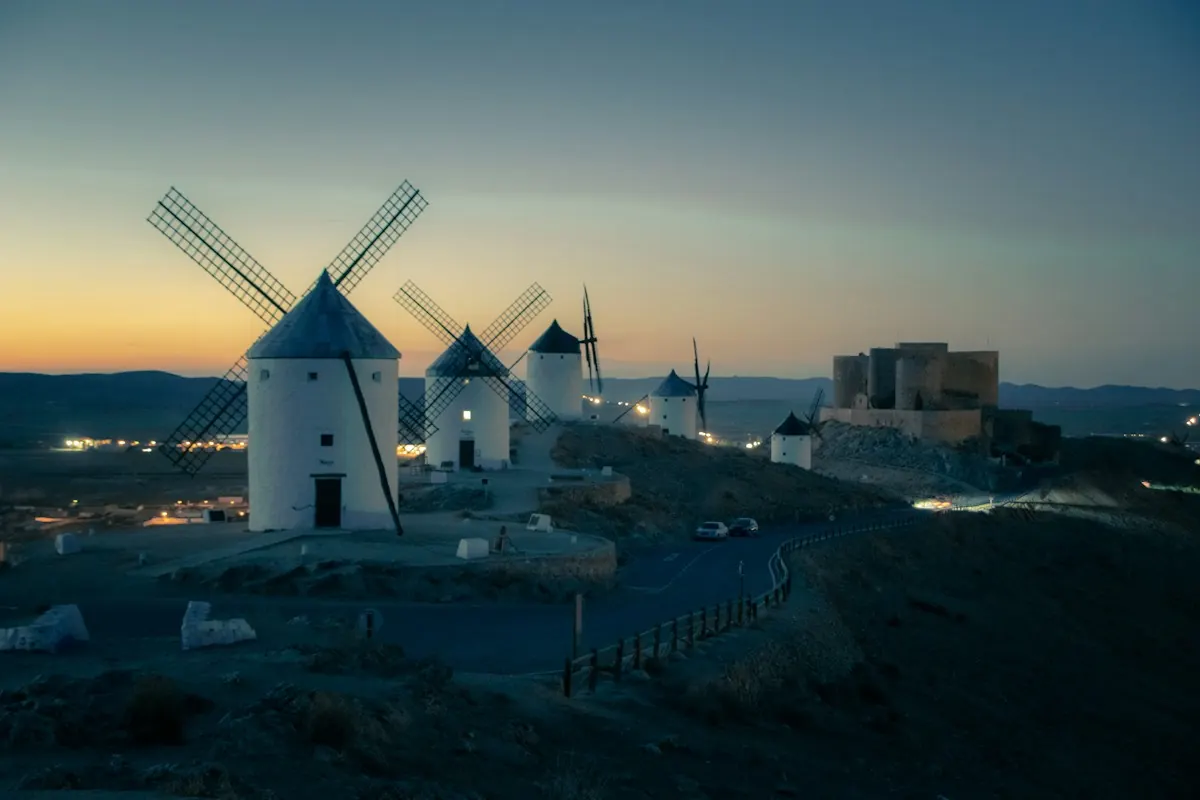
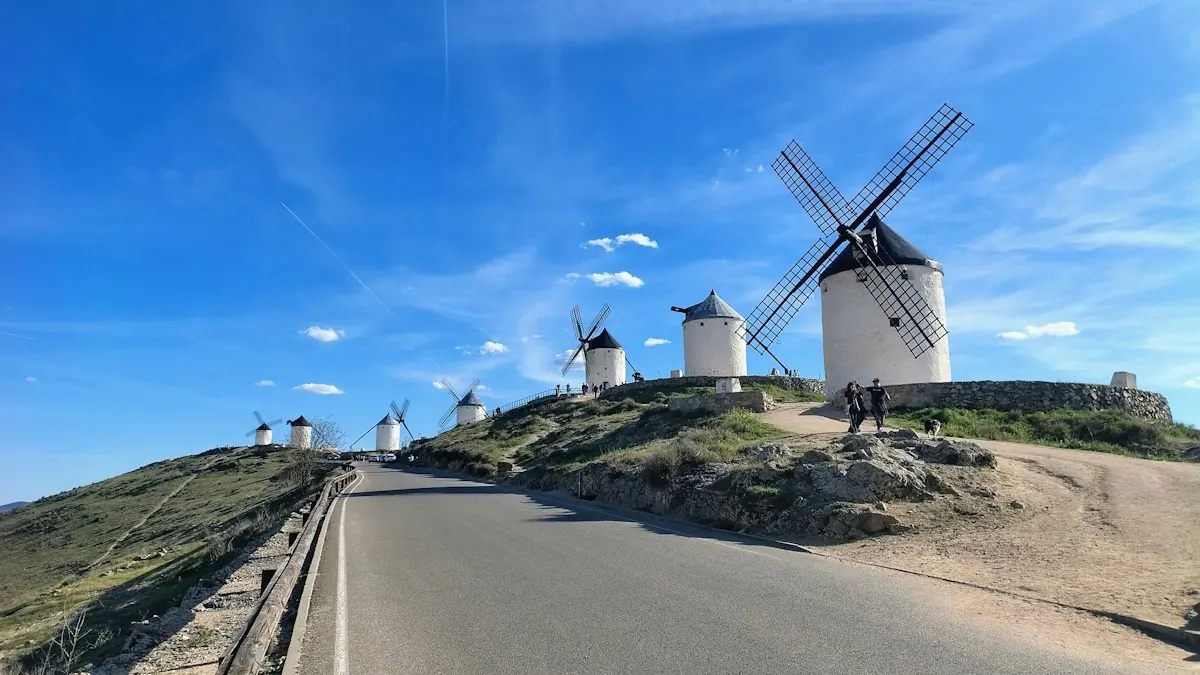
We had been riding since before dawn, Sancho on his donkey and I on Rocinante, across the plain towards Campo de Criptana. The air was clear, the land was flat and brown and open, and the sun was just climbing out of the earth when I saw, standing along a low ridge ahead of us, thirty or forty enormous figures. I counted them as well as I could. They stood in a long row, and each one had long arms stretched out to the sky, and some of them, I am sure, were turning those arms slowly round, as a man does who is limbering up for a fight.
I reined in Rocinante and turned to my squire. Sancho, I said, we have not been out a day and heaven has already laid a feast before us. Look: a whole company of giants, drawn up in a line as if they had been waiting for us. I told him I meant to fight every one, and that what we took from them would set us up handsomely, and that clearing such brutes off the plains of La Mancha was work that God Himself would bless.
01 What Sancho saw
Sancho asked me what giants I meant. I want to set down his answer here exactly, because it is important to be fair to him, and because the historian of my deeds will want both sides.
I pointed to them, there on the ridge, with their tremendous arms. Sancho looked at them for some time. Then he told me that what I was looking at were not giants but windmills, and that what seemed to be arms were the sails, which go round in the wind and turn the millstone. He said it very plainly, and he added, with what he clearly thought was good sense, that he had seen windmills all his life, that his uncle had worked at one, and that anyone who rode at them would come off the worse, since the mill would not mind and the rider would.
I told him, gently, that a man who has never had an adventure should not set himself up as a judge of them. They were giants. And if the sight of them frightened him, he was welcome to stay back and pray for me, which would be a useful service, while I went forward alone. I do not blame Sancho for his error. A squire who has spent his life among sheep and onions sees the world as sheep and onions have taught him to see it. That is precisely why a knight is needed: to see what is really there.

02 The charge
With that I gave Rocinante the spur. Behind me Sancho was still calling out about sails and millstones and his uncle, and I confess I did not listen, for when a knight has seen his enemy clearly, a squire's opinion is only so much wind. I shouted to the giants to stand their ground and not run, since they faced one knight alone, and a knight with no wish to take unfair advantage of thirty.
Just then a breeze got up, and the great arms began to turn faster, as if they meant to meet me. I called out that they might wave as many arms as the giant Briareus, who had a hundred, and it would save none of them. I gave my heart to Dulcinea in a single breath, settled my shield, lowered my lance, and drove Rocinante at a full gallop into the first of them. The point went home in the arm.
What followed was very quick. The arm came round, the lance broke into splinters, and Rocinante and I were lifted off the ground together and set down again some distance away, not gently, in a part of the field I had not intended to visit. I lay there for some time looking at the sky. Sancho arrived as fast as his donkey would trot, which is not fast, and found me unable to move.
He who rides against the wind must be ready to be answered by it.
Sancho, God bless him, told me that he had said so. He reminded me, at some length, that he had used the word windmill several times, and that his uncle had worked one, and that a man would need a very busy head of his own to take a mill for anything else. I record this too, because I have promised to be fair.
03 Frestón
I asked him to hold his tongue. In war, I told him, nothing stays the same from one hour to the next. And I explained what had plainly happened: the sage Frestón, the same who stole my books and walled up my library, had changed these giants into mills at the very instant of my charge, so that the glory of the victory might be snatched from me. He hates me that much. But I told Sancho that all his arts would come to nothing in the end against an honest sword.
Sancho said that God would sort it out, and helped me up, and got me back on Rocinante, who was walking a little crooked in the shoulder. We took the road to Puerto Lápice, which I chose because a pass so busy with travellers is bound to be thick with adventures. All the same, I was sorry about my lance.
I told Sancho, to cheer us both, about a knight of Castile, Diego Pérez de Vargas, who broke his sword in battle against the Moors, tore a limb off an oak and fought on with it so mightily that ever after he and his family were called Machuca, which is to say, the Pounder. I meant to do the same with the first good oak I found, I said, and Sancho would one day be proud to tell his grandchildren he had seen it. Sancho said he would be proud of anything I liked, but that I was sitting crooked in the saddle and might want to straighten up before I tore any trees.
I said a knight errant may not complain of his hurts, not even if he is bleeding from every joint, and so I would sit as I was. Sancho considered this and said that in that case he hoped the rule did not extend to squires, since he meant to complain of every scratch he ever got, loudly. I laughed and told him I knew of no law of chivalry that forbade it, and he could groan as much as he pleased. He then mentioned that it was past dinner time. I said I was not hungry and he should eat. He did, very contentedly, without leaving the saddle, working his way through the saddlebags and lifting the wineskin so often, and with such a look of peace, that I thought no bishop at a banquet could have been happier.
04 The night under the trees
That night we spent among some trees, and from one of them I tore a dry branch that might serve me as a lance, and fitted to it the iron head I had taken from the broken one. The oak was cooperative and I am pleased with the result; it is not the equal of my old lance, but it has the advantage of being mine by right of conquest.
All that night I did not sleep. I lay thinking of my lady Dulcinea, as the books say knights do, who spend many sleepless nights in forests and deserts, entertained by the memories of their ladies. I thought of her face, which I have never quite seen, and of her voice, which I have never heard, and I found that I had a great deal to think about. I composed in my head a letter to her about the giants, which I will send when I have a better pen, and I wondered whether she, in El Toboso, might also be lying awake.
Sancho did not lie awake. With a full stomach and an emptier wineskin he lay down under his tree like a man laying down a sack of grain, and he slept, without turning over once, until I shook him at sunrise. The birds had been singing for an hour by then, and the sun was full on his face, and neither had made any impression on him. His first act on waking was to weigh the wineskin in his hand, and his face fell, since it was lighter than he remembered and he saw no tavern on the horizon. I envied him his sleep a little. I did not envy him his dreams, which, I am fairly sure, were of onions.
To the sage Cide Hamete, who will write all this down: they were giants at dawn and mills by breakfast. Record the dawn. The breakfast belongs to Frestón.
Campo de Criptana, La Mancha