
 Spain · Summer 1614
Part of: The second sally, with Sancho Panza · 10 of 10
10 · Ox-cart home · 9 – 14 Sept
Home in a cage


Trip details
- When
- 20 Aug – 14 Sept 1614
- How long
- 26 days
- Who went
- Me, Sancho Panza, Rocinante and Dapple
- Stops
- 10
- Getting around
- On horse and donkey, home by ox-cart
In this story · 3 chapters
I was asleep in the castle on the night of the eighth of September, worn out by my labours, when I woke to find myself tied hand and foot. Around my bed stood several figures with their faces covered, who moved without a word. Before I could understand what was happening I had been lifted, carried, and set down in a sort of cage made of stout wooden bars, which they nailed shut over me. I did not resist. I understood at once that I was enchanted, and that these were phantoms of the castle, and that it is useless to fight enchanters with the arms of the body.
Then a voice spoke, very deep and full of dread, which I confess resembled a little the voice of the barber of my village when he has a cold. It told me not to grieve at my imprisonment, since it was needful to bring my adventures to a speedy end. It foretold that the fierce Manchegan lion would one day be joined to the white Tobosan dove, and that from that union would spring brave whelps who would rival the claws of their valorous father. It also told my faithful squire that he should not be dismayed, since his wages would be paid as promised. I was very much consoled, especially by the whelps.
01 A new kind of enchantment
They set the cage on an ox-cart in the courtyard, and in the morning we left, slowly, with the oxen in front, Rocinante and Dapple tied behind, the priest and the barber riding alongside with masks over their faces, and some officers of the Holy Brotherhood whom they had hired as escort. I said to Sancho that I had read a great many histories of knights-errant, but never had I read of an enchanted knight being carried in this manner, at the pace these slow and lazy animals promise. Knights are generally carried through the air in a dark cloud, or on a chariot of fire, or on a hippogriff. Perhaps, I said, the chivalry and enchantments of our time take a different path from those of old. Sancho said he did not know, not being as well read as my worship, but he dared swear that these phantoms were not altogether Catholic.
He then told me something that I had trouble accepting. He leaned close to the bars and said that the two masked men riding alongside were the priest and the barber of our village, and that they had done this out of envy of my famous deeds. And to prove it, he asked whether I had not, since being shut in the cage, felt the ordinary needs of a man, if I understood him.
I said I understood him perfectly, and that I did indeed feel them, quite urgently. “There,” said Sancho, “I have caught your worship. Everyone knows that enchanted people neither eat, nor sleep, nor talk, nor do the other thing. Since your worship wants to do the other thing, your worship is not enchanted.”
I told him he was right in principle, but that enchantments have changed with the times, and it may well be that in our age enchanted people do all that I was doing, though in the past they did not. Against new customs there is no arguing. I knew myself to be enchanted, and that was enough for my conscience. But I did ask, all the same, that I be let out of the cage for a little while to attend to the other thing. They let me out. I gave my word as a knight not to escape. I came back in by myself.

02 The canon and the procession
On the road we fell in with a canon of Toledo, a learned and pleasant man, who rode beside the cart for some miles and argued with me about the books of chivalry. He said they were all lies and nonsense, and a bad influence, and that I had a good mind that I should employ in reading the true histories of real heroes. I answered him with the plain truth: that to doubt Amadís and the Twelve Peers of France is like doubting that the sun gives light or that the ice is cold. The books were printed with royal licence, I said, and read by everyone, great and small. How could they be lies? We parted good friends, each sure the other was charmingly mistaken.
I am obliged to record two more incidents. A goatherd who joined us for a meal called me mad, and I threw a loaf at his face, and we rolled about in the grass, he and I, while the others laughed; I do not think either of us won. And towards evening we saw a procession of penitents in white robes coming down the hill, carrying an image covered in mourning, which they were taking to pray for rain. I took it for some noble lady carried off against her will by villains, and I rode at them, having been let out of the cage for supper, and one of the penitents struck me with the forked pole that held up his candle, and down I went. Sancho threw himself on my body and wept for me so loudly that the penitents feared they had killed me, and stood about apologising. They had not killed me. I asked Sancho to help me back into the enchanted cart, since there was clearly nothing more to be done in a country so hostile to good deeds.
03 Home
We came into our village at noon on a Sunday, the fourteenth of September, when everyone was in the square, so that the whole population saw the cart arrive with me lying on a heap of hay inside it. A boy ran ahead to my house. My niece and my housekeeper came out screaming, cursing all the books of chivalry that had ever been written, and they put me to bed at once. My niece wept over me. My housekeeper said the books should all be burned, forgetting, I think, that they had already burned most of them.
Sancho's wife Teresa came running to meet him. The first thing she asked was whether the donkey was well. The second was what he had brought her. He said he had brought nothing that could be seen, but that next time he would come back a governor, of an island, the best that could be found. She asked what an island was. He said she would see in time, and that she would be amazed to hear herself called Your Ladyship by all her vassals.
Read nextThe giants of CriptanaWhere this second sally began, a month and many bruises earlier.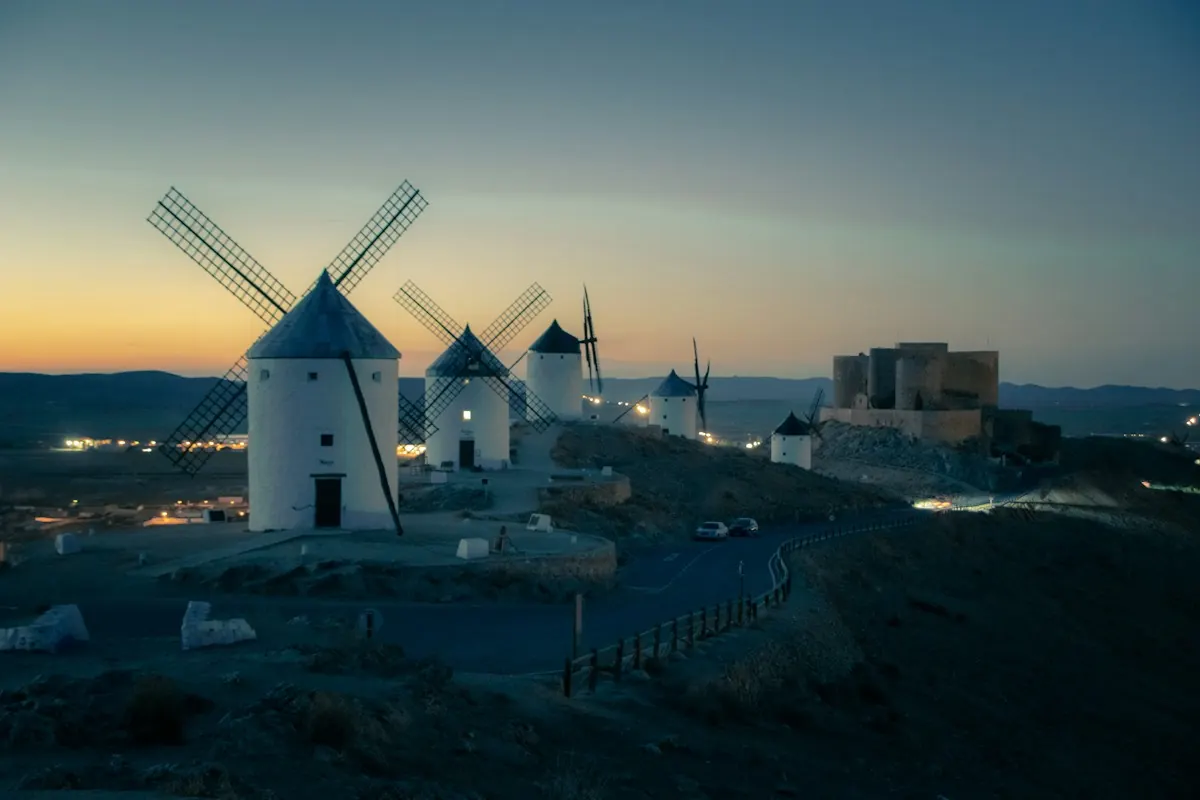
I lie now in my own bed, with my niece reading to me from a book of devotions. I am tired, and very sore. But I have heard that in the city of Saragossa there are to be jousts this year. I have not said anything about it to the household.
Esteemed Cide Hamete Benengeli, I would be glad if you wrote that I rode home in a chariot drawn by noble beasts. But you will write oxen, being an honest man, and I accept it.
An ox-cart, La Mancha